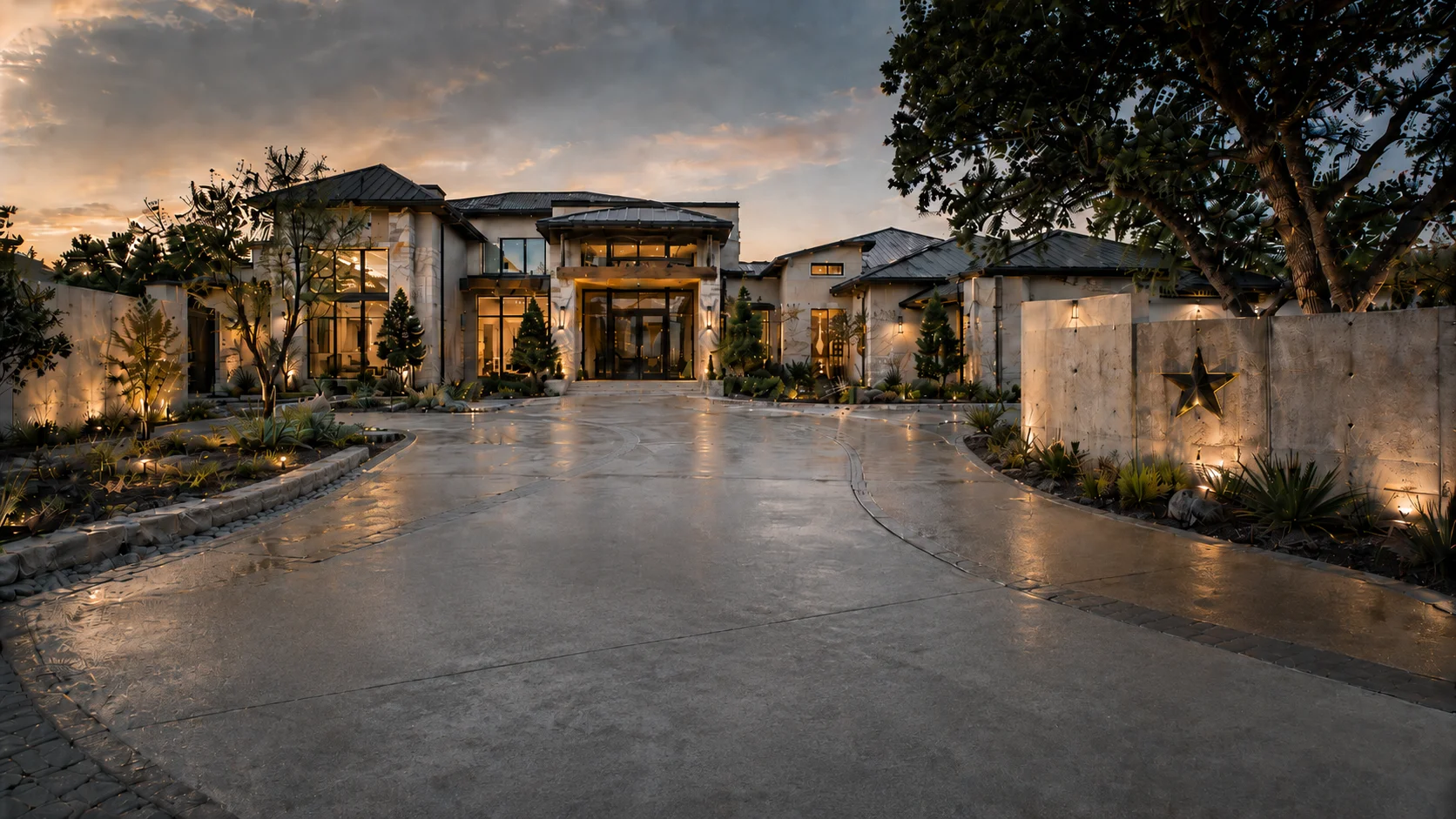
Concrete Projects in The Woodlands, TX
Driveways, Patios & Local Planning
Plan driveways, patios and concrete improvements in The Woodlands, with guidance on tree protection, drainage and Covenant reviews.
The Woodlands is the most deliberately designed community in the Guild's service area — and that word "deliberately" carries real weight. When George Mitchell began developing The Woodlands in 1974, the guiding philosophy was that the existing Piney Woods forest should survive the arrival of 120,000 residents, not be cleared to make room for them. Fifty years later, the loblolly pines and hardwoods that cover roughly 28% of the community's canopy are still here — and the Covenants, Standards, and Township governance that protect them are as active as ever.
For concrete work, that founding philosophy creates a different set of parameters than anywhere else the Guild operates. The soil in The Woodlands is sandier and better-draining than the Beaumont clay of Bellaire or the Blackland Prairie clay of DFW — which changes how sub-base work is approached. The trees create root systems that require genuine pre-project assessment, not just a glance at the site plan. And the Township's Covenant Administration process — with its Residential Design Review Committees organized at the village level — is among the most thorough approval systems the Guild navigates anywhere in Texas.
The Lone Star Concrete Guild's Woodlands chapter was built for this environment. Whether the project is a driveway replacement in a Grogan's Mill home that's approaching its 50th year, a pool deck addition in Sterling Ridge, or a full outdoor living installation in Creekside Park, the approach accounts for the trees, the soil, the drainage system, and the Covenant process that are defining features of every project in this community.
Ask about a contractor introduction
Tell us about your project. A suitable independent contractor must be confirmed before an introduction can be made. Contractor availability, an estimate and a response time are not guaranteed.
Building in the Piney Woods: Structural Planning Considerations
The first thing that distinguishes concrete work in The Woodlands from every other market in the Guild's Texas network is the soil. Understanding that difference is the foundation — literally — for everything that follows.
The Woodlands sits within the Piney Woods ecoregion of East Texas — the same geological and ecological zone that produces the loblolly pines, water oaks, and sweetgums that define the community's canopy. The soils here are categorized broadly as upland Ultisols: deep, acidic, light-colored sands and sandy loams over loamy and clayey subsoils. In plain terms, The Woodlands generally has better-draining surface soil than Houston or Dallas-Fort Worth, but with clay-bearing layers beneath the sandy surface that still respond to moisture changes.
The Tree Factor: Roots as a Structural Variable
The Woodlands' trees are the community's most defining asset — and the most consequential variable in concrete project planning. Loblolly pines, the dominant species in the community's upland areas, can grow to 80 feet in height with root systems that extend well beyond the drip line. Water oaks and other hardwoods throughout the villages have similarly extensive shallow root networks.
Over years and decades, tree roots grow in diameter. A root that passed harmlessly beneath a driveway when it was poured eventually exerts enough upward pressure to crack and heave the concrete above it. This is the source of the "mystery cracks" and uneven surfaces common in The Woodlands' older villages, particularly where driveways or walkways run near established pines.
Furthermore, excavating for a new slab or cutting through soil for sub-base preparation can sever root systems — sometimes invisibly, since root damage doesn't show on the tree immediately. In The Woodlands, where the community standard is tree preservation and the Covenants specifically require approval for any tree removal of 6 inches diameter or larger, inadvertent root damage during a concrete project is a problem that extends beyond the project itself.
What a Tree-Conscious, Woodlands-Ready Build Looks Like
Root Zone Mapping
Proactive Canopy Protection
Before finalizing the footprint of any concrete project near established trees, the root zone of significant nearby trees is identified. Critical root zones typically extend 1 to 1.5 feet from the trunk for every inch of trunk diameter. Designing around that zone minimizes root zone overlap.
Physical Root Barriers
Growth Redirection Panels
When project geometry doesn't allow complete avoidance of root zones, physical root barriers — vertical panels installed along the slab edge — redirect future root growth away from the concrete while allowing the tree to remain healthy and structurally sound.
Limestone Sub-Base
Compaction for Sandy Loam
Sandy loam requires a stable, compacted limestone base. Sandy soil that isn't properly moistened during compaction will settle rather than consolidate, undermining the base layer over time. Mechanical compaction in lifts, with attention to moisture content during the process, is the standard.
3,500 PSI Minimum Mix
Elevated Residential Baselines
For The Woodlands' conditions, 3,500 PSI is a practical floor for residential flatwork. Driveways, especially those near established trees where root movement is a long-term possibility, merit higher-strength mixes to resist deflection and localized cracking.
Control Joints Engineered for Tree Proximity
Isolating Upward Root Growth Stress
In areas where root movement is anticipated, control joint placement should account for the most likely stress points — ideally directing future cracking to clean, deep-cut joint lines rather than allowing random, unsightly cracking to fracture visible slab surfaces.
The Woodlands Covenants, Permits & Approval Process
The Woodlands is not an incorporated city, but a master-planned community governed by The Woodlands Township's Covenant Administration Department and village Residential Design Review Committees.
Township and County Permit Guidelines
All exterior home improvements in The Woodlands flow through a specific Township process, running in parallel with county-level permits:
- Township Approval is Mandatory: Submission to the RDRC is required before constructing driveways, patios, paving, or any hard-surface additions.
- Lot Coverage and Tree Protection: The Township regulates how much of a lot can be covered by hard surfaces and heavily restricts removing any live tree 6" in diameter or larger.
- County Building Permits: Work must also clear county guidelines (Montgomery County for most villages; Harris County for Creekside Park).
gavelThe Woodlands Township: Covenant Administration
All exterior modifications require prior written Township approval before work begins. Reviews evaluate compliance with lot coverage limits (capping the hard surface percentage of a lot), consistency with neighborhood appearance, drainage modifications, and tree protection standards. Applications are reviewed by village Residential Design Review Committees (RDRCs).
grid_onVillage Criteria: Layered Local Standards
While community-wide standards govern overall lot boundaries, each individual village (such as Grogan's Mill, Sterling Ridge, or Creekside Park) maintains specific Village Criteria. These criteria can govern material selection, finish textures, color specifications, and architectural rules, meaning what is approved in one village may carry different parameters in another.
mapCounty Jurisdictions: Montgomery & Harris
Township Covenant approval is separate from county requirements. Projects in Grogan's Mill, Panther Creek, Cochran's Crossing, Sterling Ridge, and most other villages must verify parameters with Montgomery County engineering. Creekside Park, sitting south of Spring Creek, is located in Harris County, which carries distinct permitting rules, stormwater requirements, and right-of-way easement laws.
Local Planning in The Woodlands' Established Villages
The Guild's local Woodlands chapter has worked extensively across the community's diverse villages, coordinating carefully with local tree canopy rules, soil conditions, and village criteria.
Grogan's Mill
The Woodlands' founding village (opened 1974) is home to aging, original-spec residential concrete. Driveway replacements here require assessing original 1970s bases, designing around mature pine and oak root zones, and planning for extensive root mitigation.
Alden Bridge
The largest village, featuring a massive housing stock built primarily in the 1990s and 2000s. Original builder-grade concrete driveways and patios are showing significant age and settlement. Active for backyard patio expansions and pool deck remodels.
Sterling Ridge
Opened in 1999, featuring craftsman-influenced architecture. Village guidelines favor cohesive, organic aesthetics like earth-toned stamped concrete or exposed aggregate finishes that complement the natural woodland architecture and craftsman profiles.
Creekside Park
The newest village, sitting south of Spring Creek in Harris County. Characterized by generous lot sizes, high-value custom estates, and modern designs. Projects often combine extensive flatwork (driveways, pool surrounds, kitchen pads) on wooded acreage.
Across these villages, ask your contractor to confirm the applicable design rules, tree protection zones and drainage easements before work starts.
The Woodlands Concrete FAQs
Important details about Township permissions, tree protection, scheduling, and engineering standards in The Woodlands.
Do I need Township approval before starting any concrete project?
Yes. The Woodlands Township's Covenants and Standards require prior written approval from the Residential Design Review Committee — or its designated staff — before any exterior modification begins. This applies to driveways, patios, paving, pool decks, and any other concrete flatwork on a lot with an existing home. Starting work before approval is a covenant violation, and the Township's Covenant Administration Department actively monitors compliance. Projects built without approval may face a stop-work process and, in some cases, required removal.
Contact the Covenant Administration Department at 281-210-3973 or visit The Woodlands Township Service Center at 2801 Technology Forest Blvd., open Monday through Friday, 8 a.m. to 5:30 p.m.
Can I remove a tree to make room for a driveway or patio?
Only with Township approval. Any live tree six inches in diameter at standard measurement height requires an application and approval before removal. Requests are reviewed in the context of the overall site, and approval may include conditions such as replanting replacement trees of a specified species and size.
Practically, tree removal for concrete projects in The Woodlands is subject to more scrutiny than in most markets — the community's founding ethos is rooted in tree preservation, and the review process reflects that. Concrete projects that can be designed to work around significant trees, rather than requiring their removal, generally move through the process more smoothly.
How long does the Township approval process take?
This varies by village, time of year, and project complexity, but for straightforward concrete projects a typical timeline runs two to four weeks from complete application submission to written approval. Applications that are incomplete — missing site plans, dimensions, material specifications, or other required documentation — restart the clock upon resubmission.
A contractor familiar with The Woodlands' application requirements can help ensure your submission is complete the first time. Common reasons for delays include insufficient drainage documentation, lot coverage calculations that weren't completed, or projects near trees that require additional assessment as part of the review.
What lot coverage limits apply to concrete in The Woodlands?
The Woodlands' Covenants and Standards include lot coverage limits that cap how much of a residential lot can be covered by impervious and semi-impervious surfaces, including all concrete flatwork. The specific percentage limits vary by village and lot type. Before designing a new patio or driveway extension, it's worth calculating your current hard-surface coverage as a percentage of your lot area and comparing it against your village's applicable limit.
A project that pushes a lot over its coverage limit will not receive RDRC approval and will require either a scaled-back design or, in some cases, the removal of existing impervious surface to offset the new addition. Your contractor or a design professional can help run this calculation as part of project planning.
What to Expect: The Woodlands Project Timeline
Typical stages to discuss with your independent contractor, accounting for The Woodlands' tree-conscious and Covenant-smart guidelines.
1. Site Assessment & Tree Evaluation
The assessment phase in The Woodlands is highly involved because the tree situation on a given lot needs to be understood before a project is designed. A contractor walks the site to identify significant trees, map approximate root zones, identify any visible root surfacing or existing heave damage, and check proximity to drainage easements or creek corridors.
2. Township Covenant Submission
A complete application to the Covenant Administration Department is drafted, including detailed site plans with dimensions, material specifications, drainage documentation, and tree protection measures. Expect a two-to-four-week review timeline from the date of complete submission.
3. County Permit (If Required)
For projects requiring Montgomery County or Harris County permits, this process runs in parallel with the Township review. County requirements for residential flatwork within property boundaries are often straightforward, but right-of-way junctions and drainage paths are explicitly verified.
4. Demolition & Site Preparation
Existing concrete is removed with careful attention to tree root exposure. Root systems encountered during demolition are evaluated rather than blindly cut — significant roots are bridged or protected. Sub-grade preparation proceeds to the appropriate depth.
5. Sub-Base Installation & Compaction
Crushed limestone base is placed and compacted in mechanical lifts with strict attention to moisture content. Compaction moisture is critical in sandy loam soils to prevent later settlement and soil erosion underneath the slab boundaries.
6. Forming, Reinforcement & Pour
Forms are set to confirmed dimensions and drainage grades. Rebar reinforcement is placed and elevated on chairs. Concrete is placed, screeded, and finished to specification. Finish selection typically utilizes organic, earth-toned stamped profiles or exposed aggregates to match established village aesthetics.
7. Curing, Joint Cutting & Sealing
Control joints are cut within the first 12 to 24 hours. The slab cures under protective covers. Decorative surfaces receive a high-quality, slip-resistant sealer once the initial curing window closes, protecting the concrete from high humidity and pine needle acidity.
8. Final Walkthrough & Handover
The completed project is reviewed with the homeowner, covering finish maintenance, sealer schedules, and what to watch for as the concrete settles into the Piney Woods sandy loam terrain over its first year of seasonal moisture changes.
Additional Woodlands FAQs
Details on typical project pricing, unpermitted work risks, resurfacing guidelines, and drainage swale constraints in The Woodlands.
My lot backs up to a drainage swale or creek corridor. Does that affect my project?
Yes. The Woodlands was engineered from the beginning with a natural drainage system — creek corridors, swales, and wetland areas that manage stormwater flow. Lots adjacent to drainage swales or creek corridors are typically subject to easements that restrict development within a buffer zone. Concrete placed within a drainage easement — even partially — can affect stormwater management and may require removal regardless of other approvals received. Proximity to active water courses also means these lots may experience faster sub-base erosion at slab edges during heavy rain events.
How does The Woodlands' climate affect concrete pouring?
The Woodlands sits in a humid, warm Gulf Coast climate zone with heavy spring rainfall and hot summers. In summer, high humidity slows surface evaporation, but high ambient temperatures cause concrete to set faster. Morning pours, water-reducing admixtures, and curing compounds are standard. Heavy spring rains also risk compromising base compaction and the water-cement ratio, so scheduling flexibility around weather patterns is essential.
How much does a concrete project typically cost in The Woodlands?
Project costs reflect scope, finish complexity, site-specific factors (tree proximity, root bridging, drainage easement considerations), and the administrative investment in the Covenant application process. Premium finishes like exposed aggregate or earth-toned stamped designs are highly valued because they align with RDRC guidelines and look cohesive with the forest surroundings.
My neighbor had concrete work done without Township approval. What happens if I do the same?
The Township runs an active compliance program, conducting regular neighborhood inspections and investigating reported violations. Unapproved work can result in a covenant violation notice, a required application for retroactive approval (which is never guaranteed), and potential required removal of the non-compliant flatwork. It can also block or complicate title transfers when selling your home.
Ready to Start Your Woodlands Project?
Whether you are replacing a 40-year-old Grogan's Mill driveway, adding an outdoor living area in Sterling Ridge, or navigating a Covenant submission in Creekside Park, you can ask about an introduction to an independent contractor, subject to availability.
*Serving The Woodlands and surrounding ZIP codes 77380, 77381, 77382, 77384, 77385, 77386, 77389, and 77393.*
Planning in The Woodlands & Surrounds
This guide covers The Woodlands project planning. Discuss local soil conditions, drainage, neighborhood rules and permitting with the independent contractor you choose.
Continue planning your project
Compare the project guidance with local soil, weather and permitting considerations. These guides describe planning areas; contractor availability is confirmed separately.
- Concrete driveways
- Pool decks
- Retaining walls
- Stamped concrete patios
- Bellaire local guide
- When Trees Compete With Your Foundation for Water: A Guide to Roots, Moisture, and Concrete
- That Hollow Sound Under Your Driveway: Understanding Erosion Voids (and Why They're Not Sinkholes)
- Polyurethane Foam vs. Mudjacking: Comparing Two Approaches to Lifting a Sunken Slab
- The Maintenance Step Most Homeowners Skip: Sealing Concrete Joints